Sunday, 28 May 2023

Additional Armaments for A Very British Civil War Chain of Command

More tanks

Even before getting to use my existing armoured vehicles in my Chain of Command - A Very British Civil War project, I have painted up a couple more, just in case (I had them built and basecoated already so I needed to get them off the painting production line).

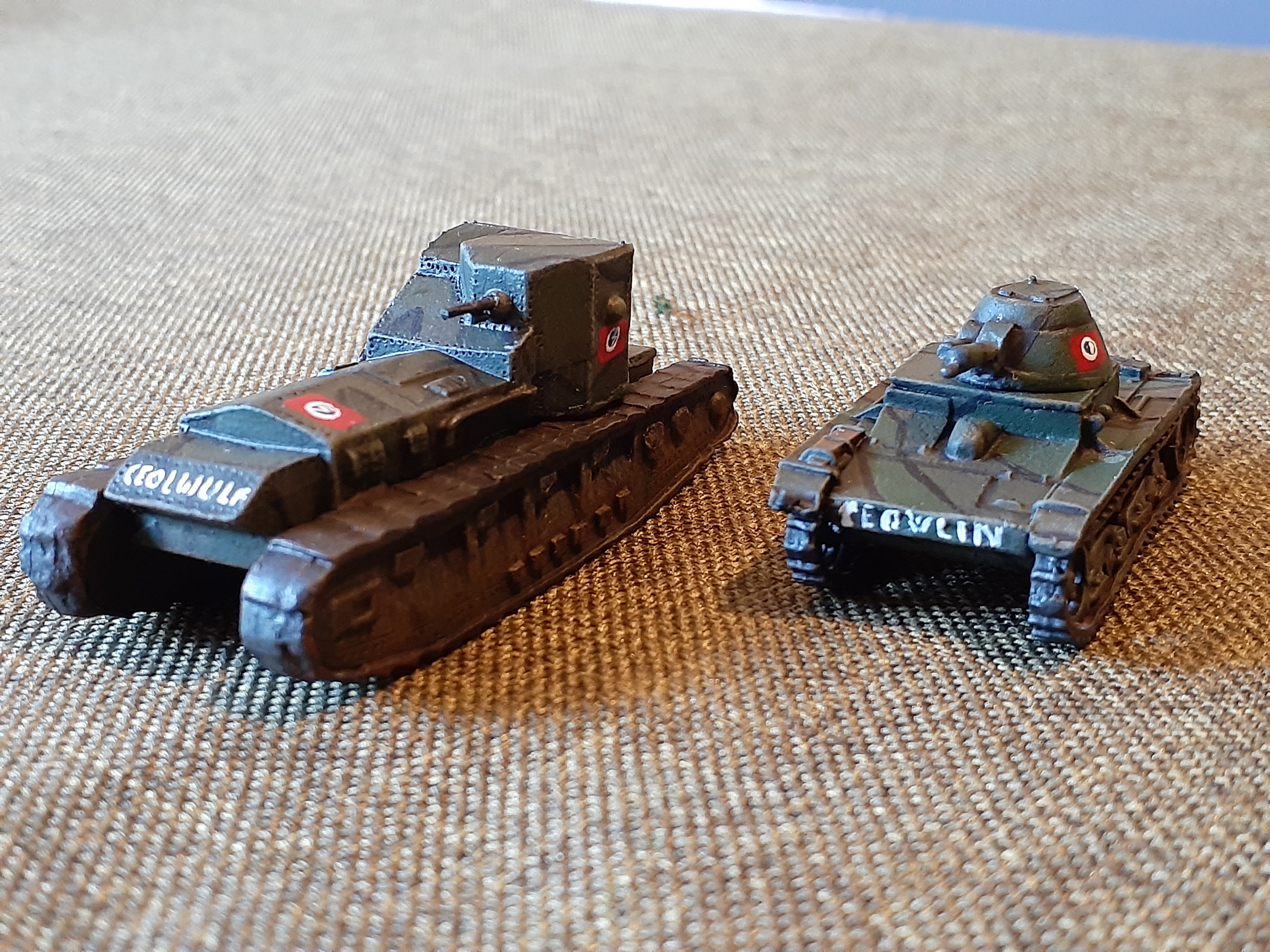
Vickers 6-Ton Type B and Vickers Medium Mark II (QRF Miniatures).

(Paper terrain via Wargames Vault).

I wanted a more modern but still British-made tank to support the Blackshorts, so the Vickers 6-Ton Type B was given their armoured vehicle paint scheme, markings, and the name 'Ceowlin'. So now there is Ceolwulf and Ceowlin in C Troop, BUF Heavy Column. Since it may be hard to distinguish the names clearly over the radio (the 'ceo' is pronounced like 'cheo', they will have to be callsigned 'Wulf' and 'Lin.' I have plans to add a third BUF tank to complete the troop but have no miniature as yet.

Two tanks of C Troop, BUF Heavy Column. Just one more tank and I've got this unit complete. 

The left-wing faction (the Manchester Commune and Sheffield Workers' militia) will be supported by Soviet-suppled armoured vehicles when I can actually find some appropriate vehicles (hopefully a Zvezda T-26 1933 model and a BT-2 but I may have to go with whatever is in shops). The newer Zvezda T-26 is a little too late for the period of our campaign. I could go with a T-35 but it would seem a rather inefficient use of smuggling resources for the Communes to ship it in leading up to the war. I guess there are enough factories and works in Sheffield and Manchester that they could produce one domestically using blueprints supplied by their external allies? Plus it might be cool to see on the table. When else am I going to use one?

The Vickers Medium Mark II is painted in the standard interwar colour scheme and will be assigned by the Regular Army to support the defence of the Mersey Corridor.

Model modifications

On both the Vickers 6-ton and the Medium Mark II, which were QRF miniatures, I did some work with Gren Stuff and balsa wood. A blob or ring of Gren Stuff is used on the base of the turret stem to keep the turret in place but still rotatable (these turrets won't be exploding into the sky when the vehicles are hit) and the balsa wood was used to form the lower hull half of the Vickers 6-ton (which is modelled with an upper hull only, which would be fine for tabletop use but I'll need it looking more realistic for close-up photos). Both these modifications were quite easy, the balsa being hardest as it needed to be cut to size and then shaved into shape with sandpaper.

Balsa wood lower hull on the Vickers 6-Ton.

Direct fire artillery

This Ordnance QF 18 pounder field gun, crewed by trained Regular Army personnel could be assigned to support either Blackshorts or Commune forces. I'm looking forward to seeing how a field gun works on the Chain of Command battlefield.


As they will be seen in action: QF 18 pdr Field Gun (QRF Miniatures).

The gun itself is a QRF miniature, the crew are Old Glory and the base is Flames of War. The limber is also Old Glory, from their OQF 25 pounder guns. Each crew figure is mounted separately on a small metal washer, is held in place by a bit of blu-tack and can therefore be removed easily when/if the gun crew sustains casualties.

The crew come off the base if they get hit.

Assembling the QF 18 pounder can be a bit tricky due to the number of parts, their fineness and the angles. I used blu-tack on a wooden base to hold the wheels in place while the glue set them to the carriage.

A considerable increase in firepower for the platoons, and a 'motivational speaker'

Until this point almost all the combatants in our Very British Civil War game have been limited to bolt action rifles and the occasional Bren or Lewis gun. Only one Thompson submachine gun has been brought along (by a certain kilt-wearing Blackshorts NCO) and he didn't really get any use from it. I'm hoping to change this with the new shipment of Bergmans and Thompsons that arrived recently - just in time for the big offensive. Additionally, the Peoples' forces on this front have had the fortune to be assigned political officers. These incredibly dedicated men (and women) expect the same dedication from the fighters under their guidance and have a licence to summarily execute those who would turn traitor to the people.

Sheffield Workers Militia platoon leader and section leader with Bergman submachine guns leading some riflemen). (Peter Pig Spanish Civil War Assault Guards NCOs and Mexican Civil War riflemen miniatures).

Blackshorts officers and NCOs with their new Thompson submachine guns ready to take the fight to the foe. (Peter Pig miniatures).

The Sergeant in helmet at left is the only one of these three I didn't convert. (Peter Pig British 8th Army miniatures).
The political officer of the Sheffield Workers Militia, Commissar Barrett Brigham Ruff, ready to prevent routs. (Peter Pig Spanish Civil War Assault Guards NCO). His rank marking is supposed to be a sickle but unfortunately ended up resembling a question mark, Ironic - "No questioning orders!")


Tuesday, 23 May 2023

Miniature painting hacks - The Spray Undercoating Gauntlet

I've always found I can never get the angles right for spray can undercoats (or basecoats? Is there a difference idk?) to cover all the underside recesses of miniatures. This means I've usually had to hand paint the undersides, which is annoying and wastes time.

Introducing the solution

It get's full coverage with minimal wastage of paint and time, and it's totally safe (if you're in full control of your spray can). Don't wear your good shirt or wristwatch when using the Gauntlet. Make sure the models are secured with blu-tack or something.

Flames of War/Battlefront Germans, a base and a 28mm sniper from Ex Manus (an Australian sculptor).


The Band of Breth'ren, be they ne'er so vile

Hold your manhoods cheap fellas: It's that 'Happy Few', that 'Band of Breth'ren', the 101st Airborne.

Since I'm getting into Chain of Command and looking for games with others (rather than just solo) I have expanded my forces to cover a broader range of battlefields and scenarios, including WW2 mid- to late-war. This was the perfect opportunity to actually finish painting up the last remaining miniatures from the Flames of War Open Fire! starter set I bought around ten years ago: the plastic US Paratrooper platoon. These had been the lowest priority in my Flames of War gaming all those years ago as I went first for Late War British and then Germans. American forces never really appealed to me for some reason, but it's time to give them a go and put these miniatures into action - to fulfil their destiny - their day of days - on the tabletop - and there I'll be with the mobile phone camera, to tell the story like a one-man HBO. (And yes I re-watched Band of Brothers to get ideas and paint schemes. I had originally painted those large American flag patches on the first guys but after some brief reading it seems there is no consensus on whether the 101st Airborne had the patches on D-Day. I left them off for simplicity.

I understand that Battlefront now has new plastic US paratroopers out, but I might as well use the miniatures I already have. Their rifle barrels are a bit fine and fragile but they are really nice models and were fun and fast to paint. The sprue is a few riflemen and mortar crew short of the platoon numbers in the Chain of Command rulebook, and I'm asking around the Flames of War community to see if I can get a few extras people don't want anymore. If I can't get any in time it's no big deal and anyway, when have paratroopers ever gone into combat at full strength? I'd assume probably never.

1st Platoon, Easy Company, 506th PIR, 101st Airborne Division assembled for combat (or something like that). The discs with Screaming Eagles on them are the Jumping-off Points.

Sweeping forward.


The mortar has a '5' (representing number of crew) pasted under a bit of cellotape so I can write over it if they take casualties. The crew can also be removed too if it comes to that.

S/SGT Teas and radio operator.

"Why is there a fence here? There's not supposed to be a fence here." LT Rich Summers channelling the spirit of his former C.O.

2nd Squad, with SGT 'Stag' Crampton leading the men, at right.

PVTs Wyatt and Lippman bring up the .30 cal to throw down some fire.

Phobos Acquisitions (Special Tasks Division)

15mm Sci-Fi Miniatures

We picked up some Maschinen Kreiger 15mm sci-fi miniatures as they were superb designs and were fun and different to paint. We used them to try out the Rogue Planet simple sci-fi/fantasy rules, which were fun, although we only got in two games before I started to think about house rules. I wrote the following to give context to our sci-fi miniature painting and gaming and decided to record it here.

Martian Enterprises

Some years after the first manned missions to Mars opened the planet up economically, extensive efforts were made by several corporations to set up mining and energy production operations. However, strong competition and hazy application of earth laws lead some corporations having to 'go kinetic.' Security and defence systems were hastily adapted to the hostile environmental conditions on Mars and deployed by these corporations to defend and expand their resource leases and protect the peace of mind of their shareholders.

Phobos Acquisitions

Phobos Acquisitions is an enterprise that is really going places (to Mars), and is at the forefront of extraplanetary resource development. Phobos Acquisitions is proud of its Special Tasks Division, which is at the cutting edge of security technology and goal-oriented strategy in non- or semi-atmospheric and low-to-zero gravity environments and employing a diverse workforce. Shareholders can be assured that their investments are in safe hands with Phobos Acquisitions.

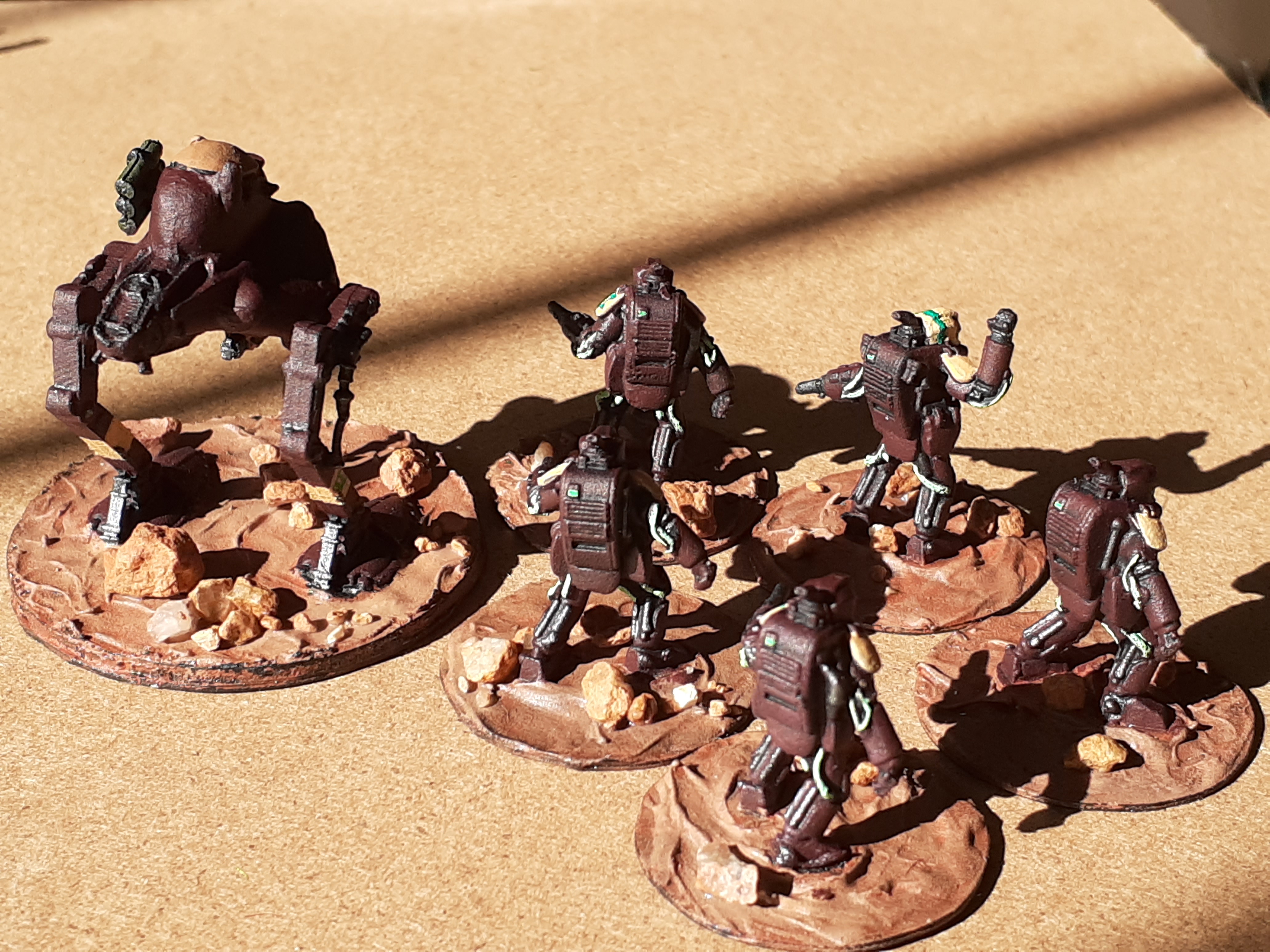
Phobos Acquisitions Operational Security Team (Ma.K IMA AFS Mk.1 suits and Goblin Walker from Slave 2 Gaming - a local Australian company).

Rear detail.


Phobos Acquisitions Artificial Intelligence Armoured Column (15mm sci-fi armoured vehicles from the Armoured Digital game (a great and innovative game in itself and with some incredibly inventive miniatures. Armoured Digital was also created locally in Australia).


The larger vehicle second from lead is the Armoured Digital mobile command centre. The next vehicle along is a supply vehicle and the last is a self-propelled artillery piece.


Saturday, 22 April 2023

The Blackshorts Legion

 (for Chain of Command, A Very British Civil War, in 15mm).


The Spode Flag of the Blackshorts Legion (one day there will be a standard bearer in 15mm).

The force I will be commanding, at least most of the time, in our introductory Chain of Command Very British Civil War campaign - the 'Mersey Corridor' will be Roderick Spode's Blackshorts Legion. Designing, preparing and painting this force has been a lot of fun.

The Platoon

The Blackshorts, originally a small, insignificant and much-ridiculed political club, has found its calling and grown in strength and seriousness in the building drama of the lead-up to the British Civil War. With an original support base limited to the area in and around Hertfordshire, and sidelined by the BUF, with war looming, the Blackshorts Legion began recruiting throughout the country during 1937. Blackshorts Legion detachments and flying columns are of varying sizes due to different levels of local recruitment and difficulty marshalling their volunteers. Likewise these volunteers are of varying military quality, ranging from transfers from the Regular and Territorial Army and Great War veterans, to the barely trained. A Blackshorts Legion platoon is relatively well armed for a political militia at this stage in the Civil War and are organised along the lines of a British Army rifle platoon. However, they are short of personnel. I may change the structure of this platoon, but currently in Chain of Command, the Blackshorts platoon looks like the following:

COMMAND: 1st Lieutenant (Senior Leader) with pistol; 2nd Lieutenant or Sergeant (Senior Leader) with pistol, rifle or SMG; 2 Rifleman runners.

There are only two sections per platoon, each with:

Sergeant, Corporal or Lance Corporal (Junior Leader) with rifle or SMG; a Bren Team of 3 crew; a Rifle Team of 8 Riflemen.

They are Green (-6) with 4 Command dice.

The Platoon Command team currently includes a radio operator, which is planned as an element in a future scenario.


The Infantry

I went with Peter Pig miniatures for the infantry in this force because they are exact 15mm, robustly modelled (good for individually based figures) and are available in an extensive range of unique and characterful poses. Peter Pig also sells a wide variety of heads for headswaps, which can add even more variety and character.

The Blackshorts at the range for a bit of marksmanship practice.


Headswaps on 15mm miniatures

I certainly made the most of headswaps for the Blackshorts to give them the look of a political militia rather than a regular force. This included replacing around half of the Brodie helmet heads on the 8th Army figures with British forage caps, and replacing the turban/beard heads on kneeling and firing Indian Army riflemen with either forage caps or the Brodie helmets sawed off other figures who now sport the forage cap. Most of the headswaps turned out very well. The main things to keep in mind to do these 15mm headswaps right are: 1. use a jeweller's saw to remove the heads from figures to preserve the original head for use on other figures, 2. keep the 'neck-pole' when you clip heads off the head sprue, 3. drill a hole to the exact size of the aforementioned 'neck-pole' to slot the new head into, and 4. when you drill this neck hole, place it a bit further back than you would normally expect because otherwise the chin and face of the new head may look like it juts out too far.

The Blackshorts Rifleman in the foreground is a headswap to the forage cap. The Sergeant directing the column behind him is an unconverted Peter Pig Home Guard figure. In this picture you can also see the rank marking on the Sergeant's base.

Headswaps being done (Peter Pig miniatures).


Basing 15mm infantry for Chain of Command

Standard infantry are on 18mm round bases unless they are prone figures, in which case they are on a base cut to size to fit them. In Chain of Command it is important to know where your leaders are at all times, so I put them on 23mm round bases and add a rank symbol on them so I know whether they're a Junior (Lance Corporal, Corporal or sometimes Sergeant) or Senior Leader (Lieutenant, W.O. or Platoon Sergeant). I haven't done so yet, but I will start placing a subtle mark on the bases of figures with special weapons such as LMGs, SMGs or AT rifles so they are easier to spot too in the heat of battle.

Bases are hand-cut from magnetic L/P-Plates (most sheet magnets would probably do) to allow storage and safe transportation on metal trays. You can trace out the right circles with washers of the appropriate size. Figures are attached to the bases by placing them into an application of Selleys No More Gaps. Super glue works also, but Selleys has the benefit of building up the bases smoothly.

The Vehicles

One of my main reasons for wanting to play Chain of Command in the Very British Civil War alternative timeline is the vehicles. The transport parks and frontline armoured units will be populated by an array of different, often weird or rickety, interwar tanks that almost never appear in the usual games of mid-20th century warfare, WW1 relics given an oil change and pressed into service, loans from intervening foreign powers, improvised armoured vehicles slapped together in revolutionary factories in Sheffield or workshops in the countryside and prototypes or 'never-was' designs that one or the other faction would rush into emergency production.

I am gradually building my collection of small numbers of these vehicles as support choices for the different factions, starting with my Blackshorts Legion Flying Column.

This first batch of vehicles are from QRF Miniatures, which sells a lot of the unusual things I need. The downside is that unfortunately many of these miniatures need a bit of work to assemble to a good standard where they will survive rigorous use (see below).

(I will aim to add more vehicles to this article in the future as I assemble and paint more).

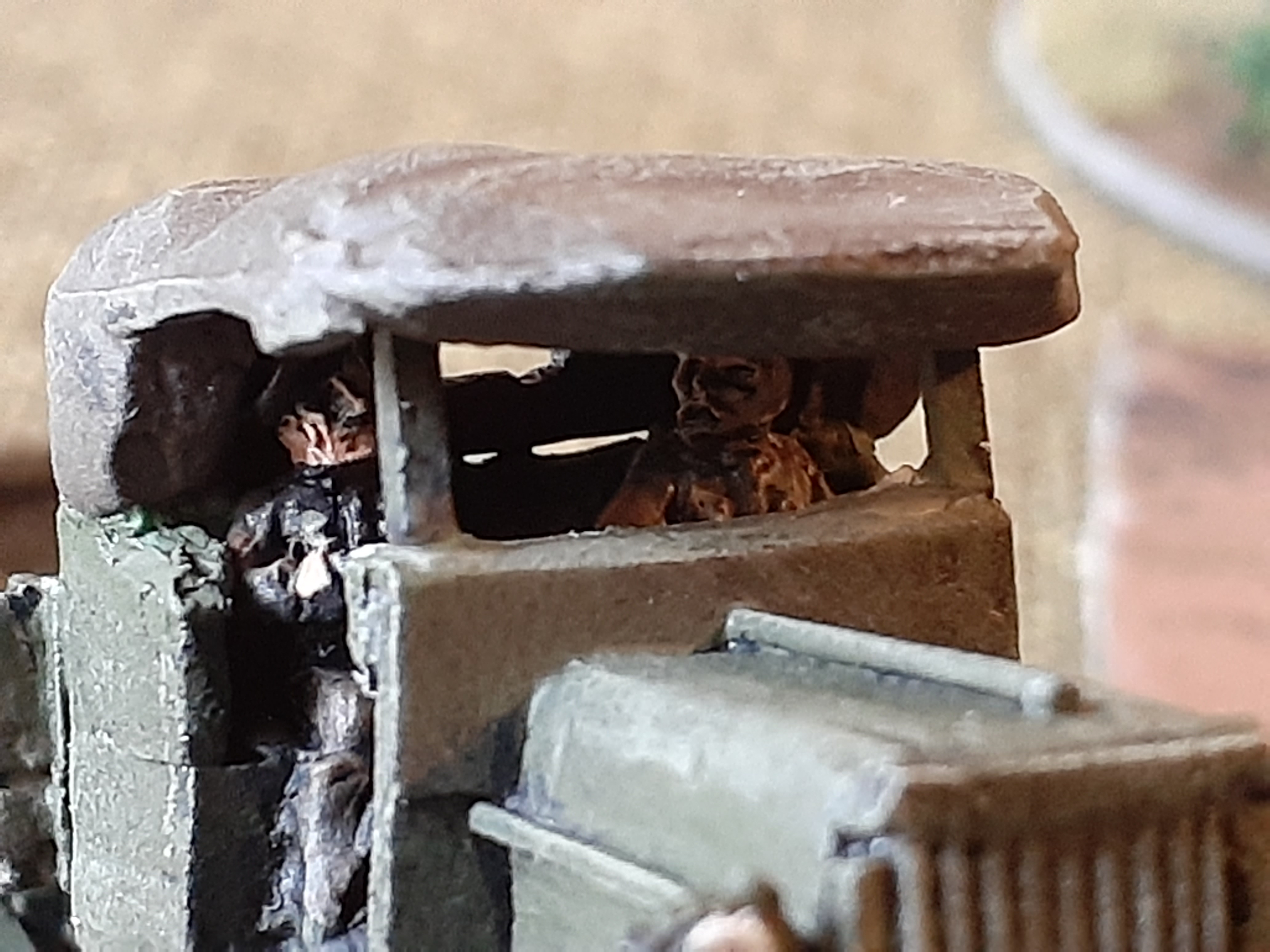
WW1-vintage Thornycroft J truck (QRF Miniatures, with driver and co-driver figures from Old Glory miniatures and adjustments and driver's legs made from Green Stuff).

Rolls Royce armoured car (QRF Miniatures).

Medium A Whippet tank "Ceolwulf" with the Blackshorts Flying Column (QRF Miniatures).


A QRF Medium A Whippet receiving structural strengthening by fitting nails through horizontally drilled holes.

The Whippet finished.

QRF Thornycroft J truck with strengthened axles (nails) and springs (plastic card).

Blackshorts Legion detachment moving up to the front.

"Ceolwulf" leading the way.


Regular Army troops watching the column pass (Peter Pig 'Brits having a brew', QRF truck and tank, Old Glory truck crew).


Watch the flanks.

The Rolls Royce armoured car brings up the rear.


Sunday, 16 April 2023

Patrol at Barton Moss Aerodrome, 27 February 1938: Chain of Command Battle Report

We had our first proper game of Chain of Command recently. We are doing a short campaign set in the 'Very British Civil War' alternative timeline using 15mm miniatures. I have also used Platoon Forward to develop the key personalities of the Blackshorts 14 Platoon, who I will be commanding through the campaign.

I didn't get many photos of the battle, but here is what I have.

The Campaign

The first battle of the campaign is a Patrol mission. This small scenario will help us get the hang of the basics, with a minimal number of figures painted and few special rules to know. After the Patrol will be a Probe, then a number of linked battles representing the late February 1938 offensive launched by the Manchester Commune, with support from the Sheffield Workers Republic, against the Royalist forces and their BUF allies along the Mersey Corridor - a very narrow and vulnerable point along the line of the Mersey River and where Royalist-held territories are the narrowest.

The purpose of this offensive is:

 - firstly, to link the Socialist Communes and Workers Republics of the cities in England's industrial heartland with the (neutral but left-leaning) Free City of Liverpool in order to gain access to safer seaports through which they can trade their industrial goods for food and facilitate further external support (i.e. tanks, guns and planes from the Comintern and international volunteers).

 - secondly, to cut off the Royalist north (Lancashire) from the rest of their territories and breaking their linkage with both the Home Fleet at Fair Isle and the remaining British holdout in Ireland at Carrickfergus.

The Game


Map of the table and outline of the action. (Map based on an Ordnance Survey Map of the period from the website Old Maps Online https://www.oldmapsonline.org/).

A BUF Blackshorts reconnaissance detachment, 14 Platoon from the 5th Company of the Blackshorts Legion and a light platoon from the Sheffield Workers Militia (SWoM) engaged in a short firefight upon running into each other in the fading light of 27 February as they patrolled the contested areas around Barton Moss Aerodrome and nearby Salteye Brook at the western edge of Manchester.

The SWoM with a number of Lewis light machine guns moved up as far as the edge of the wooded area along Salteye Brook but were unable to advance further as they encountered fire from a Blackshorts Bren team from 1 Section which had set up behind an embankment to their left.

A section of 19 Sheffield Militia emerge from the treeline and advance toward the aerodrome (Peter Pig miniatures, Spanish Civil War, Mexican Civil War, WW1 and WW2 ranges).

Accurate rifle fire from the Sheffield Militiamen took down two of the Blackshorts' Bren team (Lance Corporal Franklyn and Rifleman Hale, both with serious but non-fatal wounds), but the Bren's automatic fire was kept up, with two more men being transferred from the section's rifle team to help load the weapon.

This Rifle team, which had advanced along the embankment to the edge of Salteye Brook, itself engaged in a brief exchange of fire with a Sheffield Militia rifle section across the brook, after which both sides withdrew.

The Sheffield Militia corporal and possibly one or two other men were seen to fall, but Rifleman Nowel was also hit and killed.

1 Section moves along the embankment to the Brook while their Bren team exchanges fire with the Sheffield Militia (Peter Pig British 8th Army).

At this point, the Blackshorts Platoon Commander 1LT Lockie Heath deployed a 2" Mortar Team to fire upon the Sheffield militia but after only a few seconds firing it was found that the Mortarmen did not bring all the rounds they had been allotted, only having brought six with them. The Platoon Commander shook his head at their amateurish mistake and turned away. (Later, it turned out that the amateurish mistake was mine: I had misinterpreted the light mortar ammo exhaustion rule to my own detriment).

Blackshorts 2" Mortar team in action. They were out of ammunition in seconds.

To the 1LT Heath's left, 2 Section waited at the edge of an orchard, their Corporal, Jeff Abbey, apparently frozen in indecision. 1LT Heath ran over, yelling and waving the section forward. They got up and running to the tall grass near the Liverpool Road.

Blackshorts 2 Section line up at the edge of the orchard waiting for their Corporal's command.

2 Section then spotted about 20 Sheffield militiamen advancing in the open and began an intense firefight with them. In the ensuring battle three Blackshorts Riflemen were hit (with Rifleman Austin Keys slightly wounded, Masterson severely wounded and Paddon killed outright). The fire of the Blackshorts was inaccurate however, killing only one or two enemy and wounding their section leader. They did manage to pile on the shock though, in concert with 1 Section's Bren gunner.

While this fire pinned the enemy section, 1 Section Corporal Blain, fuming and brandishing his Thompson SMG, seized the opportunity to run along the treeline on his side of Salteye Brook to try and take the enemy in the flank in a close assault.

The Sheffield Militia section was in a lot of trouble. With their Corporal hit and the other section and the medic across the brook and unable to help, the charge of Corporal Blain's men, with their bayonets fixed, was too much for the battered Sheffield Militiamen and they fled the field.

As the sun went down on 27 February, the Blackshorts had driven the Socialists away from Barton Moss Aerodrome up to the northwest edge of Salteye Brook and as far as Peel Cemetery, at the cost of six casualties including two badly wounded and one killed.

Not wanting to be exposed too far forward, and with a Socialist offensive apparently developing, Blackshorts 14 Platoon pulled back to the buildings at Foxhill and set up pickets for the night.

Thoughts on the Chain of Command rules.

I enjoyed the game, and I hope my opponent did too. We had to check a few rules and spent time talking, but overall the game didn't take too long (probably three hours).

It is important to get your Patrol markers and therefore Jumping-Off Points reasonably far up the table and into useful spots. It is also important to make effective use of terrain, and it seems to be a good idea to have your units mutually supporting and try to catch enemy in a crossfire. Furthermore, in Patrol missions where you don't have many Support Points and can't have fixed field defences, a medic is particularly useful: a combination of a wounded section leader and rolling no '1s' on Command Dice can really get your units into trouble, and a medic can get you out of it.

Some more photos of a solo Patrol scenario I played beforehand to practice the rules mechanics:
Sheffield Militiamen scout across Salteye Brook (Peter Pig Mexican Civil War government troops).

Blackshorts riflemen (Peter Pig British 8th Army, including many with headswaps).

Sheffield Militia rifle team at the edge of a wheat field (Peter Pig Assault Guards).

Manchester Commune-aligned Local Defense Volunteers (Peter Pig Spanish Civil War range and WW2 range Home Guard NCO).


The Corporal of a Sheffield Militia section runs over to direct his troops (Peter Pig Home Guard NCO, WW1 British Lewis gunner and Czech Legion miniatures).

Blackshorts riflemen run along a hedge line (Peter Pig 8th Army with headswaps to sidecaps).